
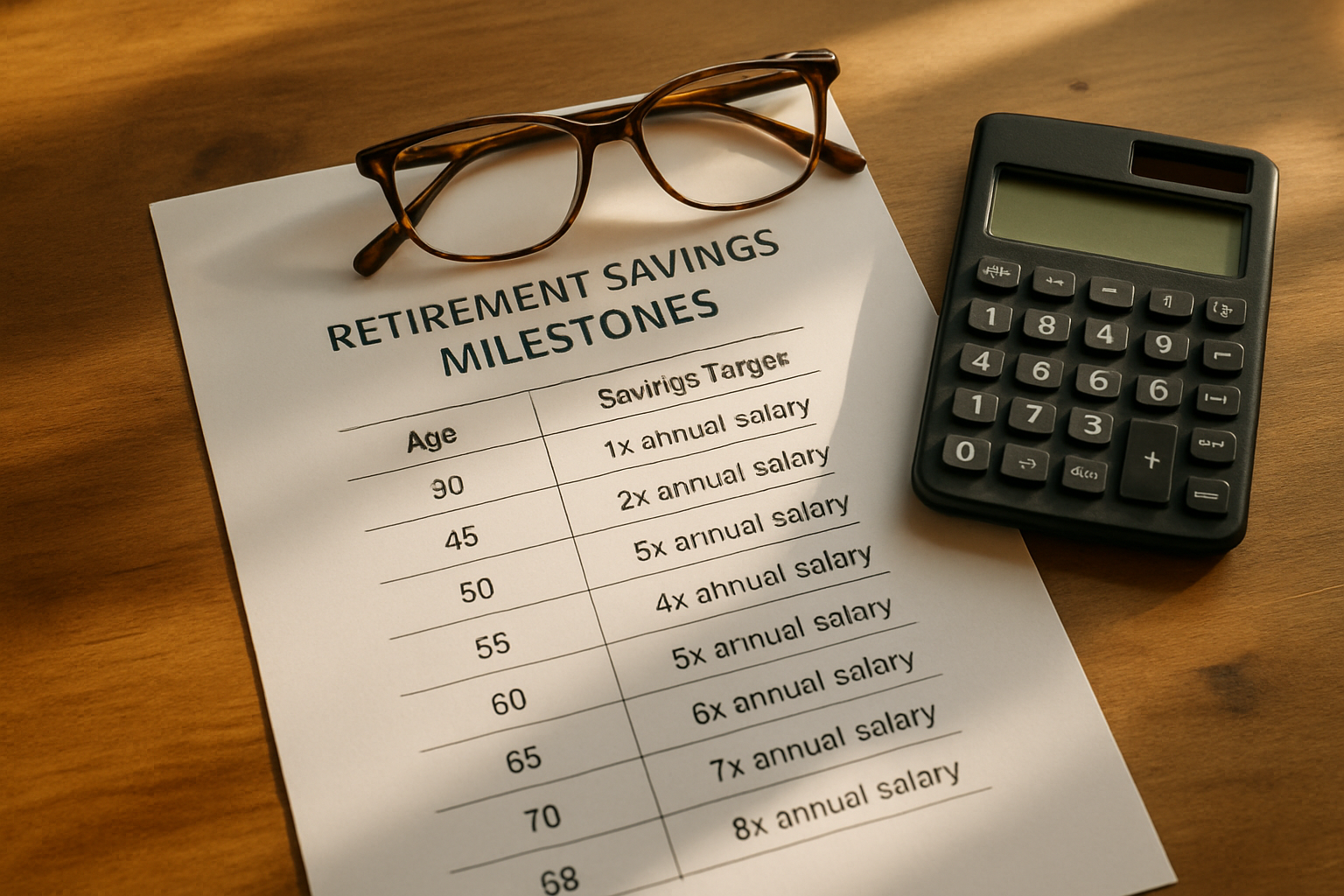
Retirement savings by age gives you a concrete way to measure whether you’re on track, ahead, or behind for a financially secure future. Financial professionals generally recommend saving a multiple of your annual salary at key milestones. Understanding those benchmarks helps you make smarter decisions at every stage of your working life.
Key Takeaways
- Most financial professionals recommend saving 1x your salary by 30, 3x by 40, 6x by 50, and 8x by 60.
- Starting early matters because compound growth does the heavy lifting over decades.
- Catch-up contributions are available for Americans 50 and older in both 401(k) and IRA accounts.
- Where you retire can affect how far your savings go, especially regarding state income taxes on retirement income.
- A fiduciary financial advisor can help you build a personalized plan if general benchmarks do not fit your situation.
Table of Contents
- Why Age-Based Retirement Savings Benchmarks Matter
- Retirement Savings Targets by Decade
- How to Close the Gap If You’re Behind
- Factors That Change Your Retirement Savings Number
- Things to Know
- Match With a Vetted Retirement Planner Today
- Frequently Asked Questions
Why Age-Based Retirement Savings Benchmarks Matter
Saving for retirement without a target is like driving cross-country without a map. You might eventually arrive, but you’ll waste time and resources along the way. Age-based retirement savings benchmarks give you an objective checkpoint. You can assess your current position and adjust your contributions accordingly.
Moreover, you can modify your investment strategy or retirement timeline based on where you stand. The most widely cited benchmarks come from Fidelity Investments. These recommendations suggest having 1x your salary saved by age 30, 3x by 40, 6x by 50, 8x by 60, and 10x by age 67.
These targets assume a retirement age of 67. They also assume a consistent savings rate of 15% of income starting at age 25. Additionally, they expect a portfolio that maintains a moderate equity allocation throughout your career. These are useful starting points, but they are not one-size-fits-all rules. Your actual target depends on your expected retirement lifestyle, projected Social Security income, healthcare costs, and whether you carry debt into retirement.
Furthermore, understanding how those factors interact is where professional guidance pays off. Asking yourself do i need a financial advisor is a reasonable first step before your next big financial decision.

Retirement Savings Targets by Decade
Your 30s: Building the Foundation for Retirement Savings
By age 30, Fidelity’s benchmark suggests having 1x your annual salary saved. If you earn $60,000, your goal is $60,000 in retirement accounts. This is the decade to maximize your 401(k) contributions. Especially if your employer offers a match, leaving that match unclaimed means giving up free compensation.
The IRS sets annual 401(k) contribution limits each year. For 2025, the limit is $23,500 for employees under 50. Contributing consistently through your 30s, even at a modest rate, allows compound growth to begin doing significant work over the following decades.
Your 40s: Accelerating Retirement Savings Contributions
By age 40, the target moves to 3x your salary. If you earn $80,000, you should have approximately $240,000 saved. The 40s are often when incomes rise substantially. This creates a real opportunity to accelerate contributions and close any gap from your earlier years.
However, this is also a decade when financial complexity increases. You may be managing a mortgage, college savings for children, and career transitions simultaneously. Prioritizing retirement over other savings vehicles, particularly non-deductible savings goals, keeps your long-term trajectory on course.
Your 50s: Catching Up on Retirement Savings
The benchmark at 50 is 6x your salary. At this stage, the IRS allows catch-up contributions for Americans 50 and older. For 2025, the catch-up contribution limit for 401(k) plans is an additional $7,500 per year beyond the standard limit. IRA account holders 50 and older can contribute an extra $1,000 annually above the standard $7,000 cap (IRS.gov, 2025).
If you are behind at 50, this decade is critical. Reducing discretionary expenses pays off immediately. Paying off high-interest debt frees cash flow for retirement accounts. Channeling that money into retirement savings can make a significant difference. Furthermore, knowing how to improve your credit score when you have high credit card balances can also reduce interest costs and redirect that money toward savings.
Your 60s: Finalizing Your Retirement Savings Plan
By age 60, Fidelity recommends 8x your salary. This climbs to 10x by age 67. At this point, your focus shifts from accumulation to distribution planning. You will need to decide when to claim Social Security. Moreover, you’ll need to determine how to draw down tax-deferred accounts efficiently.
Additionally, you should consider whether your portfolio allocation should shift toward income-producing assets. Required Minimum Distributions (RMDs) begin at age 73 under current IRS rules. Therefore, the years between 60 and 73 offer a valuable window for Roth conversions and tax-efficient withdrawals.
How to Close the Gap If You’re Behind
Falling short of age-based retirement savings benchmarks is common. According to the Federal Reserve’s Survey of Consumer Finances, many American households have retirement savings well below recommended thresholds. If that describes your situation, here are the most effective ways to catch up:
- Maximize tax-advantaged accounts first. 401(k)s, IRAs, and HSAs all offer tax benefits that a standard brokerage account does not.
- Take advantage of catch-up contributions if you are 50 or older.
- Delay Social Security. Each year you delay claiming beyond your full retirement age, your benefit increases by approximately 8% up to age 70 (Social Security Administration).
- Reassess your retirement date. Working two to three additional years meaningfully reduces the number of years your savings must cover. This gives your portfolio more time to grow.
- Reduce pre-retirement spending. Identifying and cutting recurring expenses that do not align with your priorities frees cash for savings.
Moreover, broader economic conditions can also affect your timeline. Awareness of signs of recession can prompt you to adjust your investment allocation and spending habits before a market downturn erodes portfolio value.
Factors That Change Your Retirement Savings Number
The salary-multiple benchmarks assume a specific set of circumstances. Your actual retirement savings target may be higher or lower depending on these key factors:
| Factor | Impact on Savings Target |
|---|---|
| Retiring early (before 62) | Significantly higher savings needed |
| Pension or defined benefit plan | Lower personal savings required |
| High healthcare costs | Larger buffer required |
| Mortgage-free retirement | Lower income needed |
| High-cost vs. low-cost state | Can shift the target substantially |
The state you plan to retire in affects how far your savings stretch. Some states tax Social Security benefits and retirement distributions fully. Others do not. Reviewing the best states to retire for taxes 2026 can help you factor geographic tax efficiency into your overall plan.
Things to Know
- Benchmarks assume a 15% savings rate starting at 25. If you started later, your required rate increases.
- Social Security replaces roughly 40% of pre-retirement income for average earners. Personal savings must cover the rest (SSA.gov).
- A Roth IRA can be a powerful tool in your 30s and 40s if you expect to be in a higher tax bracket during retirement.
- Saving in a Health Savings Account (HSA) provides a triple tax advantage and can offset significant retirement healthcare expenses.
- Do not conflate total net worth with retirement savings. Home equity is not liquid and should not count toward these benchmarks without careful planning.
Match With a Vetted Retirement Planner Today
Retirement savings benchmarks give you a roadmap, but they cannot account for your specific income, goals, or risk tolerance. If you are unsure whether you are on track, now is the right time to act. Additionally, you may need a personalized strategy to catch up.
Best Financial Advisors connects you with vetted, fiduciary-minded retirement planners and investment professionals across the country. We match professionals to your goals and location.
Call us today to get matched with a retirement planning professional who can help you build a strategy grounded in your actual numbers.
Match Me With a Retirement Planner
Frequently Asked Questions
Q: How much should I have saved for retirement at age 35?
Most financial professionals recommend having approximately 1.5x to 2x your annual salary saved by age 35.
If you earn $70,000 per year, a reasonable target is between $105,000 and $140,000 in retirement accounts by that age. This range accounts for those who started saving in their mid-20s at a consistent rate and have not taken early withdrawals.
Q: What counts as retirement savings for these benchmarks?
Retirement savings for benchmark purposes includes 401(k), 403(b), IRA, Roth IRA, and pension balances, but generally excludes home equity and taxable brokerage accounts.
Home equity is an asset, but it is not liquid in the same way a retirement account is. Taxable brokerage accounts can support retirement income. However, they lack the tax advantages that make qualified accounts the priority.
Q: Is it too late to start saving for retirement at 50?
No, starting at 50 still gives most people 15 to 17 working years before a conventional retirement age, which is a meaningful accumulation window.
The IRS catch-up contribution provisions exist specifically for this group. These provisions allow higher annual contributions to both 401(k) and IRA accounts. Delaying Social Security, reducing expenses, and working with a financial planner to optimize your strategy can make a significant difference even when starting later.
Q: How does inflation affect retirement savings targets?
Inflation erodes purchasing power over time, which means your nominal savings target must be higher than it would appear in today’s dollars.
Historically, inflation in the United States has averaged around 3% annually over long periods. Recent years, however, have seen higher rates. This is why maintaining equity exposure in your portfolio, even close to retirement, is often recommended as a hedge against inflation.
Q: What if my employer does not offer a 401(k)?
If your employer does not offer a 401(k), your primary tax-advantaged options are a Traditional IRA or Roth IRA, and if you are self-employed, a SEP-IRA or Solo 401(k).
The annual contribution limits for these accounts are lower than a standard 401(k). This makes it more important to invest consistently and consider taxable brokerage accounts as a supplement. Therefore, a retirement planner can help structure contributions across multiple account types to maximize tax efficiency.